Compiled from both manufacturers' published datasheets. Verify with samples and the PCB footprint before production.
The VOOHU WHSG48001G is a functional alternative to the Mentech G4802CG — verify with samples in your design. Both are 48-pin SMD LAN transformers on a 1.02 mm pitch, with eight channels for two 100/1000BASE-T ports, a 27.80 × 12.20 mm body no taller than 7.50 mm, at least 350 µH of OCL under 8 mA of DC bias, a 1500 VAC, 60 s hipot and a 0 to 70 °C operating range. As drawn, both schematics wire all 48 pins alike. Two differences deserve a look before release. The suggested pads are 0.64 × 2.34 mm on the Mentech drawing and 0.64 × 1.90 mm on the VOOHU drawing, while the outer edges almost coincide at 16.44 and 16.50 mm. And the OCL and leakage limits share the same numbers but are measured at different test voltages: 0.2 V for Mentech, 0.1 V for VOOHU.
#Where the G4802CG and WHSG48001G datasheets agree, and where they part
The Mentech column comes from the G4802CG Product Specification for Approval, version A0, issued 27 April 2020: outline and suggested pads on page 2, schematic and electrical table on page 3, packing on page 4, reflow and moisture sensitivity on page 6 (printed page numbers). The VOOHU column comes from the WHSG48001G datasheet, revision A0: outline, suggested pads and schematic on page 1, electrical characteristics and packing on page 2. Mentech prints a minimum, nominal and maximum for some dimensions and a single nominal value for the rest; VOOHU prints nominal ± tolerance, or a typical value for the pads. All lengths are in millimetres, and not stated means the document does not give the value.
#G4802CG land pattern vs. WHSG48001G: the outer edge holds, the inner edge moves
Overlay the two suggested patterns and the outline of the footprint barely shifts. Both drawings use 0.64 mm pads on a 1.02 mm pitch with 23.46 mm from the first pad to the last, and the outer edges of the two rows sit 16.44 mm apart for Mentech and 16.50 mm apart for VOOHU, a difference of 0.03 mm per side. The pads themselves, though, are 2.34 mm and 1.90 mm long. Because the outside edges nearly line up, almost all of that 0.44 mm lands at the inner end of each pad. Calculated from the published dimensions, the inner edges are 11.76 mm apart on the Mentech pattern and 12.70 mm apart on the VOOHU pattern, so each G4802CG pad reaches about 0.47 mm further toward the middle of the part.
Now put the body on top. Both parts are 12.20 mm wide at nominal. An inner pad edge 11.76 mm across runs about 0.22 mm under each side of the body; at 12.70 mm it stops about 0.25 mm short of it (both calculated at nominal width, and the ±0.50 mm body tolerance moves these figures). The leads are not what changes: they measure 15.24 and 15.20 mm across with a 0.90 mm foot on both drawings, so at nominal dimensions the feet sit on copper with either pattern. What changes is how much copper and paste lies behind the heel of each foot, on 48 joints with 0.38 mm between neighbouring pads (calculated). For a board already built on the Mentech pattern, the decision is whether to trial the WHSG48001G on those pads or redraw them at the next respin; either way, create a separate WHSG48001G footprint from its page-1 drawing rather than renaming the G4802CG one, so a future layout picks up the 1.90 mm pads. No written FAE confirmation covers the Mentech pattern yet, so let a first-article build settle the trial.
#Stencil, paste and reflow: what the assembler should plan for
On the placement side little changes: the body is still 27.80 × 12.20 mm with a 7.50 mm maximum height, so the body outline in the placement program stays the same; the reel count moves from 300 to 350 parts per reel. The paste is where the attention goes. A stencil cut for 2.34 mm pads prints paste along the full pad, including the inner portion that ends up under the edge of the body, where a top-down AOI camera cannot see a solder ball or a bridge. If you trial the WHSG48001G on existing Mentech pads, agree the aperture with your stencil supplier before the build, and inspect the first article at the inner ends of the joints, by side view or X-ray, as well as for bridging across the 0.38 mm gaps. For the reflow sheet, Mentech's page 6 gives MSL 1 and a SAC305 profile peaking at 245 °C. The WHSG48001G datasheet does not state MSL or a reflow profile, so do not copy the Mentech entries into the process documents for the new part; ask us for them in writing before the first production lot.
#Same OCL limit, different test voltage: what it means at incoming inspection
Both OCL limits read 350 µH minimum at 100 kHz with 8 mA of DC bias, and both leakage limits 0.5 µH maximum, but Mentech applies a 0.2 V test signal and VOOHU 0.1 V. On paper the numbers match; on the LCR meter they are two different tests. If your incoming inspection, or a bench comparison of the two parts, keeps the 0.2 V setting written for the G4802CG, the WHSG48001G is being measured outside the condition its limit is defined at, and a pass or a fail at that setting does not show whether the part meets its own datasheet. Write the WHSG48001G line of the inspection sheet at 100 kHz, 0.1 V and 8 mA, and record the test level next to every reading so that data from the two suppliers are not mixed later.
Three Mentech entries have no counterpart on the VOOHU sheet: a second hipot level of 1650 VAC for 6 s, interwinding capacitance of 35 pF maximum, and the MSL and reflow data above. Both sheets share 1500 VAC at 1 mA for 60 s. If your production line runs a short hipot at 1650 VAC for 6 s because the Mentech sheet allowed it, or a design review quoted the 35 pF figure, ask us for written WHSG48001G data at those conditions instead of carrying the Mentech values over; our article on why an Ethernet port fails the Hi-Pot test puts the hipot in context. Two more lines are written differently rather than missing. DCR is 1.2 Ω maximum on the Mentech sheet and 1.4 Ω maximum on the VOOHU sheet, and crosstalk is −35 dB from 0.5 to 40 MHz followed by a formula on one, −30 dB from 1 to 100 MHz on the other. Neither comparison says how either part will behave in your link. Where an approval document quotes these lines, take the limits from the WHSG48001G datasheet and let your own link tests confirm the port.
#G4802CG to WHSG48001G: an eight-step swap check
#Where the WHSG48001G fits
The WHSG48001G belongs on boards that carry two 100/1000BASE-T ports through one 48-pin, 1.02 mm-pitch transformer, inside equipment that stays within 0 to +70 °C, which is the operating range on both datasheets. Neither datasheet lists a PoE or DC current rating, so this comparison covers ports that do not carry power over the data pairs. If the same product also uses the single-port Mentech G2401CG, our G2401CG comparison works through that pair, where the pad difference shows up at the outer edge instead.
SolutionEthernetInterface + magneticsView solution →#FAQ
What is an alternative to Mentech G4802CG?
The VOOHU WHSG48001G is a functional alternative to the Mentech G4802CG — verify with samples in your design. Both are 48-pin, 1.02 mm-pitch SMD LAN transformers with eight channels, a 27.80 × 12.20 × 7.50 mm maximum-height body, 350 µH minimum OCL at 8 mA DC bias, a 1500 VAC, 60 s hipot and 0 to 70 °C operation. Check two points: suggested pads of 0.64 × 2.34 mm against 0.64 × 1.90 mm, and an OCL test voltage of 0.2 V against 0.1 V.
Is the G4802CG a dual-port Ethernet transformer?
Its schematic shows eight channels, PHY side on pins 1 to 24 and line side on pins 25 to 48, which is the channel count for two 1000BASE-T ports; the document title reads 100/1000 BASE-T transformer. The WHSG48001G datasheet shows the same eight-channel arrangement, and its product page lists it as dual port.
Is the G4802CG body 28.3 × 12.7 mm?
Those figures are the top of the Mentech tolerance. The specification gives the body as 27.80 mm long (27.30 to 28.30) and 12.20 mm wide (11.70 to 12.70), with a 7.50 mm maximum height. The WHSG48001G is drawn at 27.80 ± 0.50 × 12.20 ± 0.50 mm, also 7.50 mm maximum, which, calculated from the tolerance, gives the same upper limits of 28.30 and 12.70 mm.
Can the WHSG48001G go on the G4802CG land pattern?
Plan it as a trial. The outer pad edges are 16.44 mm apart on the Mentech drawing and 16.50 mm on the VOOHU drawing, but the Mentech pads are 0.44 mm longer, and calculated from the published dimensions they reach about 0.47 mm further inward on each side. Agree the stencil aperture with your assembler and confirm with a first-article build; no written FAE confirmation covers the Mentech pattern yet.
#Send your G4802CG footprint with the sample request
When you request WHSG48001G samples, attach the land pattern from your G4802CG board, the stencil thickness and aperture data, and the incoming inspection conditions you use today. Samples are available for evaluation, and selected parts are free of charge. Our FAE team will be glad to confirm the options for your project. Our FAE team can suggest suitable parts and help check the design — here, how the WHSG48001G sits on 2.34 mm pads with a 16.44 mm outer edge, which stencil aperture to start the trial from, and which test conditions to write on your inspection sheet.
VOOHU supplies RJ45 and SFP connectors, LAN and PoE transformers and common mode chokes from Suzhou, China, to more than 1,500 customers.
Other 48-pin, 1.02 mm-pitch transformers sit next to it in our LAN transformer selector, already filtered by pin count and pitch.
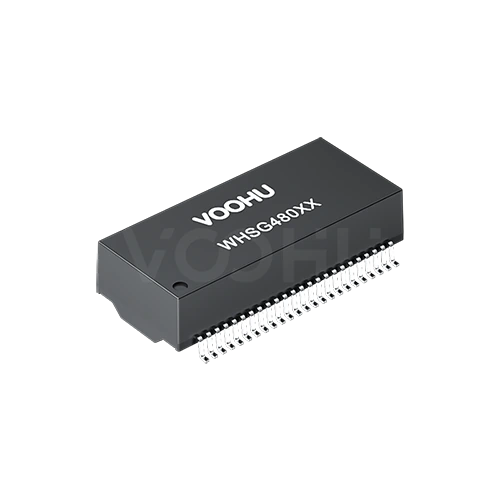
Related product: WHSG48001G, a dual-port LAN transformer for 100/1000BASE-T. Eight 1CT:1CT channels, each followed by a line-side two-wire common mode choke, sit in a 48-lead SMD package on a 1.02 mm pitch, 27.80 × 12.20 mm and no more than 7.50 mm tall. Per its datasheet, OCL stays at 350 µH minimum with 8 mA of DC bias, isolation is tested at 1500 VAC for 60 s, and the operating range is 0 to +70 °C.
Need a quote, samples or selection support?
Part number WHSG48001G is filled in for you. Add the quantity and lead time and submit. Our FAE team will be glad to confirm the options for your project.
Before you order: samples, MOQ, lead time and import duties in our ordering guide →