

Data rate
Match the target PHY mode; neither winding count nor the highest test frequency establishes the link rate.
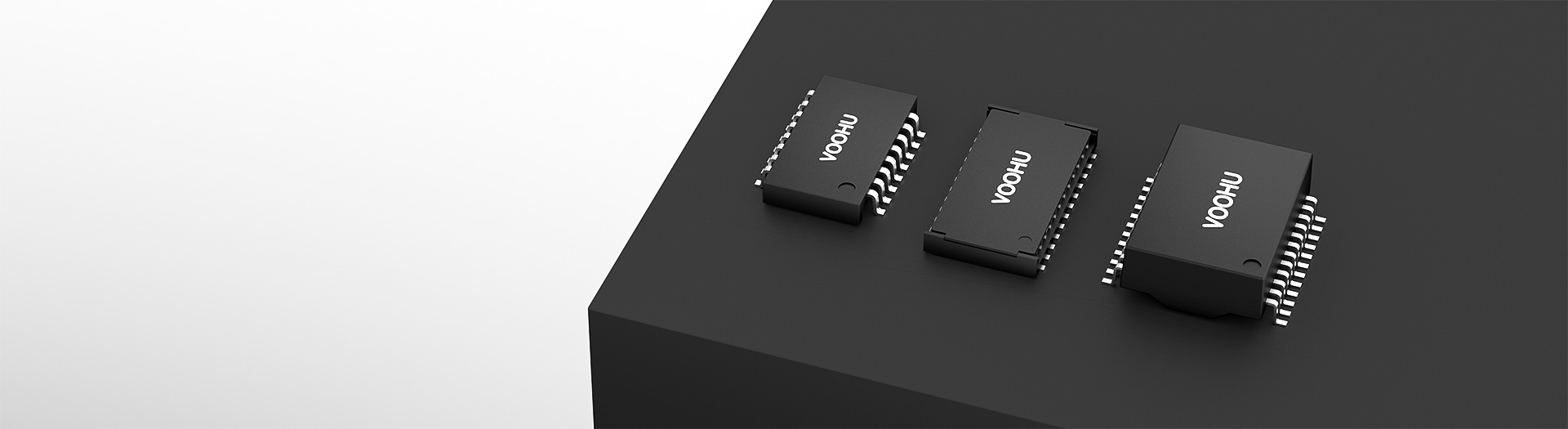
Ethernet magnetics
Find discrete Ethernet transformers for switches, industrial gateways, routers and other copper Ethernet interfaces. Browse VOOHU 10/100, Gigabit, 2.5G/5G, 10G and 18G product ranges by rate, ports, mounting, temperature and PoE needs. Open part-specific design files, request samples or pricing for a known part, or contact our sales engineers for FAE-assisted selection and replacement review.
Part number search & selector
The selection table follows the current VOOHU China selector workflow, with English labels and published English-site product links.
* Frozen Image and Part Number columns · drag horizontally to review all specifications
| Image | Datasheet | Compare | Downloads |
Data Rate
|
Mounting Method
|
Ports
|
Pins
|
Pitch
|
Operating Temperature
|
Vt (V RMS)
|
PoE
|
Sample |
|---|
| Image | Part number | Datasheet | Compare | Downloads | Data Rate | Mounting Method | Ports | Pins | Pitch | Operating Temperature | Vt (V RMS) | PoE | Sample |
|---|---|---|---|---|---|---|---|---|---|---|---|---|---|
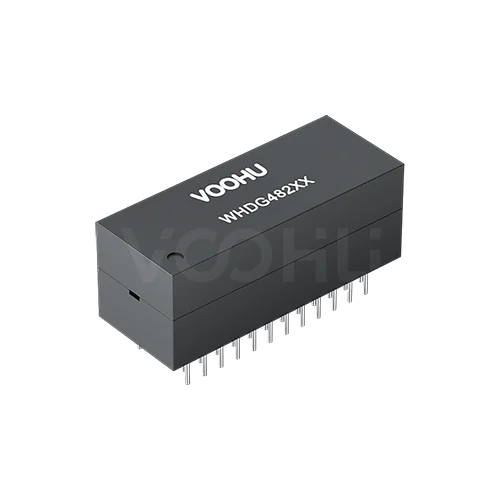 |
WHDG48209G | SPEC | 10/100/1000 Base-T | DIP | Dual Ports | 48 Pin | 2.0mm | 0 up to 70 °C | 1500 | Non-PoE |
|
||
|
|
WHDG48201-1G | SPEC | 10/100/1000 Base-T | DIP | Dual Ports | 48 Pin | 2.0mm | 0 up to 70 °C | 1500 | Non-PoE |
|
||
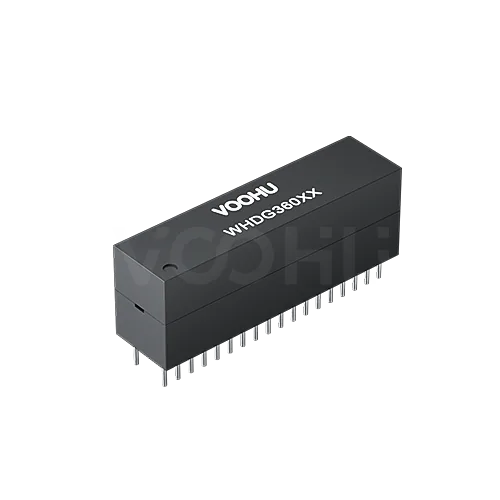 |
WHDG36002G | SPEC | 10/100/1000 Base-T | DIP | Dual Ports | 36 Pin | 1.78mm | 0 up to 70 °C | 1500 | Non-PoE |
|
||
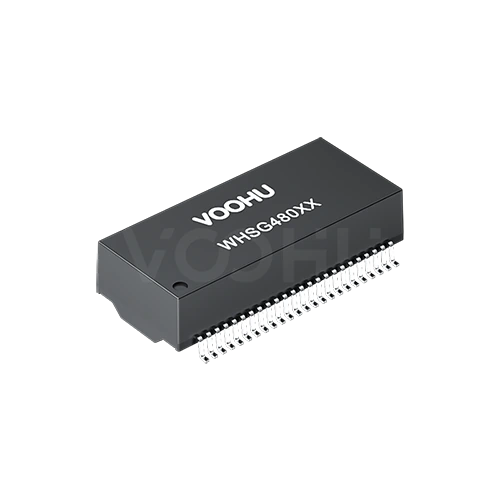 |
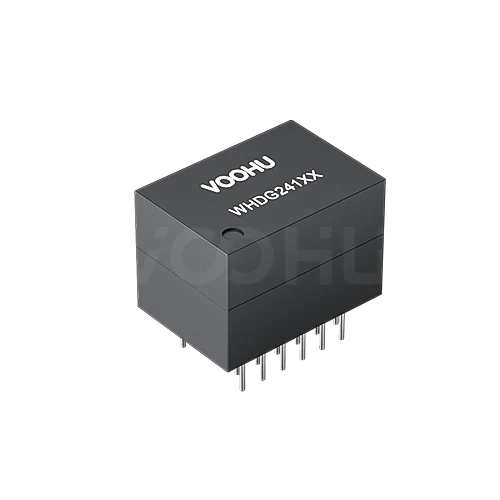
WHSG48002P G | SPEC | 10/100/1000 Base-T | SMD | Dual Ports | 48 Pin | 1.02mm | -40 up to +85 °C | 1500 | PoE+ (up to 900 mA) |
|
||
 |
WHDG24102G | SPEC | 10/100/1000 Base-T | DIP | Single Port | 24 Pin | 2.0mm | 0 up to 70 °C | 1500 | Non-PoE |
|
||
|
|
WHDG24101G | SPEC | 10/100/1000 Base-T | DIP | Single Port | 24 Pin | 2.0mm | 0 up to 70 °C | 1500 | Non-PoE |
|
||
|
|
WHDG48201T1 | SPEC | 10/100/1000 Base-T | DIP | Dual Ports | 48 Pin | 2.0mm | -40 up to +85 °C | 1500 | Non-PoE |
|
||
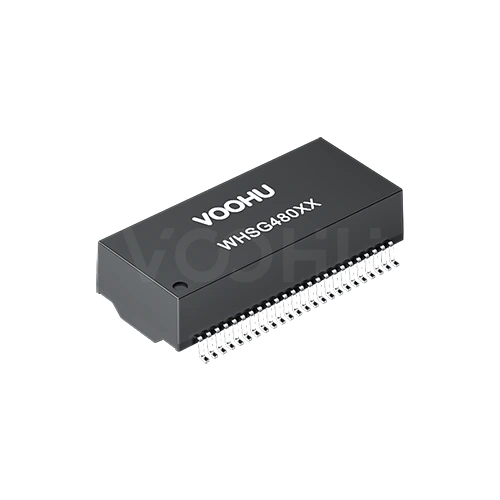 |
WHSG48001K1 | SPEC | 10/100/1000 Base-T | SMD | Dual Ports | 48 Pin | 1.02mm | 0 up to 70 °C | 2500 | Non-PoE |
|
||
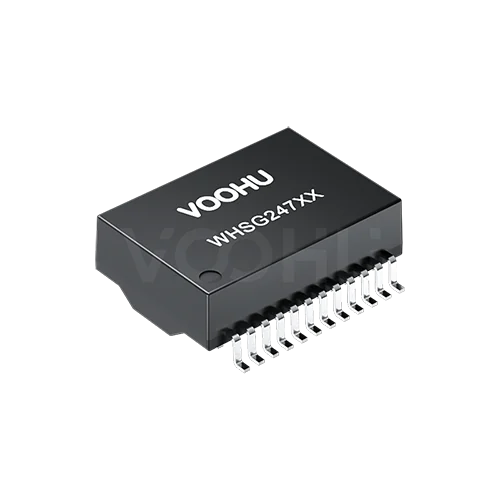 |
WHSG24701F0 | SPEC | 10/100/1000 Base-T | SMD | Single Port | 24 Pin | 1.27mm | -40 up to +85 °C | 4000 | PoE+ (up to 720 mA) |
|
||
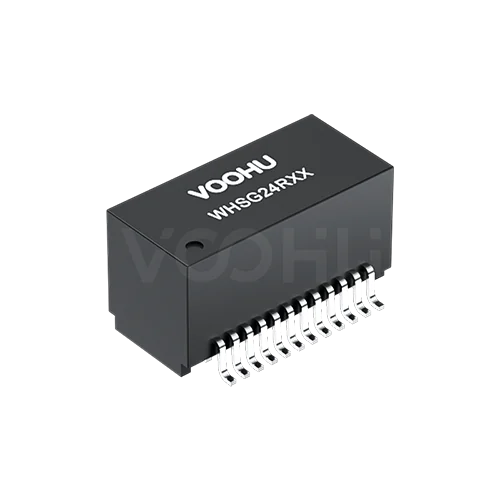 |
WHSG24R05N0 | SPEC | 10/100/1000 Base-T | SMD | Single Port | 24 Pin | 1.0mm | 0 up to 70 °C | 1500 | Non-PoE |
|
||
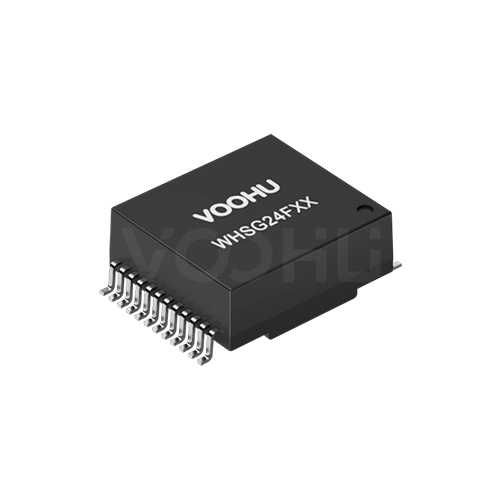 |
WHSG24F05P0 | SPEC | 10/100/1000 Base-T | SMD | Single Port | 24 Pin | 0.99mm | 0 up to 70 °C | 1500 | PoE+ (up to 720 mA) |
|
||
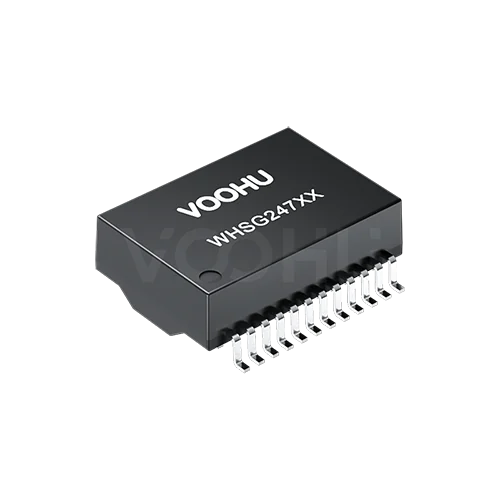 |
WHSG24705N0 | SPEC | 10/100/1000 Base-T | SMD | Single Port | 24 Pin | 1.27mm | 0 up to 70 °C | 1500 | Non-PoE |
|
||
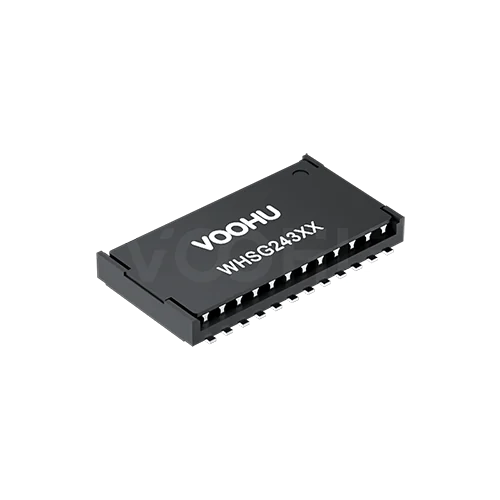 |
WHSG24301T1 | SPEC | 10/100/1000 Base-T | SMD | Single Port | 24 Pin | 1.27mm | -20 up to +105 °C | 1500 | Non-PoE |
|
English catalog snapshot captured 7 August 2026. The selection interface is based on the current VOOHU China LAN transformer selector, while part links and technical files remain tied to the English catalog snapshot. One duplicated published SKU remains listed under both source URLs pending CMS canonical confirmation.
Broaden the selected filters or clear the current search.
Product family quick links
Counts reflect the current public selector data.
How to select
Start with the system constraints that eliminate unsuitable parts, then compare package and downloadable design files.
Target PHY, link rate, port count and whether the port sources or receives PoE power.
Compare mounting, temperature and space for new designs; check the original footprint, pin functions and height early for a no-board-change replacement.
Turns ratio, center taps, OCL test conditions, insertion loss, return loss, isolation test and PoE current definitions.
Request samples for a shortlist, ask FAE for matching support, or request a quote for a known part and quantity.
Key selection parameters
Match the target PHY mode; neither winding count nor the highest test frequency establishes the link rate.
The number of network ports served by the module, not a calculation from pin count.
Distinguish SMD, through-hole/DIP and low-profile options; check row spacing, footprint and pin orientation.
Distinguish operating and storage ranges and any temperature-rise condition; “industrial” is not a substitute for a specified range.
Retain AC/DC, duration and test-limit conditions; a withstand-test voltage is not a continuous working-voltage rating.
Distinguish non-PoE parts from expressly supported PoE options; retain current definitions such as each channel and full channels.
Product family comparison
Use this table as the first routing step, then verify the exact part-number fields. Family membership does not imply that every part shares the same mounting, temperature, isolation or PoE value.
Return to the selector ↑Technical performance & application fit
Application suitability is part-number specific. Treat the catalog fields as a shortlist, then confirm the design against the linked technical files.
Downloads & technical resources
Search a full or partial SKU, then open its datasheet, 3D model or PCB footprint without returning to the product table.
Showing representative complete file sets. Search to find a specific SKU.
VOOHU’s published product content is reviewed by its engineering team. Specifications, downloads and technical support information are tied to specific part numbers, so you can verify them before requesting samples or a quotation.
Category overview
Every copper Ethernet port needs one, but the selection turns on three things: speed, PoE and whether the magnetics sit in the connector.
Discuss a new design
Contact FAE for a replacement assessment.
Already have a part number? Request samples or a quote.
The transformer sits between the PHY and the RJ45, coupling the signal magnetically so no direct connection exists between cable and board. That gives the isolation the Ethernet standard requires and rejects common mode noise picked up along the run. It is not an optional filter.
A part specified for 10/100 will not hold signal integrity at gigabit, and a gigabit part may not survive 2.5G or above. Return loss, insertion loss and crosstalk are all specified against the speed the part is rated for. Select against the highest speed the link will ever run, not the speed it launches with.
Power over Ethernet puts DC current through the centre taps, so the transformer must be rated for the bias current the PoE class demands. A non-PoE part in a PoE design saturates and the link degrades or fails. Confirm the PoE class first, then filter on it before anything else.
FAQ & related guides
These answers guide the page workflow. Part-specific engineering limits still come from the linked technical files.
In this context, both terms refer to signal magnetics for copper Ethernet interfaces. Still distinguish discrete transformers, RJ45 connectors with integrated magnetics and PoE power transformers. This page is for selecting discrete LAN transformers.
Matching the rate is only an initial filter. Check the PHY requirements, ports, PoE, temperature, internal connections and PCB footprint. Start with the rate for a new design; check the footprint and pinout alongside it when replacing an existing part. Share the PHY or current part number to help us narrow the options.
There is no universal connection for every PHY. Distinguish PHY-side and cable-side center taps and follow the target PHY reference circuit, transformer schematic and PoE architecture for connections and decoupling. Do not copy another PHY’s circuit without checking it. Share your PHY and schematic for an FAE review.
PoE-capable Ethernet magnetics provide signal coupling and isolation while accommodating the port’s power path under specified connection and current conditions. A PoE power transformer serves the associated DC-DC power conversion stage. They are not interchangeable. Tell us the target PHY, PSE/PD role and power requirements.
Those two dimensions do not establish compatibility. Check row spacing, footprint, pin functions, center taps, turns ratio, magnetic structure and electrical limits. FAE can review the existing part and identify differences requiring validation. This page does not provide an unchecked drop-in replacement verdict.
Align frequency range, test voltage, temperature, DC bias and Min/Max/Typ definitions before comparing the relevant limits. Read negative-valued or formula-based return-loss specifications using the datasheet’s convention. An OCL test’s DC bias is not a PoE current rating. Use the complete datasheets when the comparison conditions are incomplete.
A discrete design lets you select the magnetics and RJ45 jack separately. A MagJack integrates magnetics into the connector. Choose based on PCB space, interface construction, PHY requirements, PoE and assembly constraints—not an assumption that either approach always has better signals or lower cost. Do not add a separate transformer to an already magnetically integrated interface without reviewing the design.
For a known part, send the part number, quantity and destination to request samples or pricing. If no part is selected, start with the application, target PHY or existing component. A sales engineer handles the request and involves FAE for matching or customization. Stock, price and lead time are confirmed per part and order; custom designs also require electrical, dimensional and validation requirements.
Engineer support
Send the candidate part number and the condition you need reviewed. Sample support can be added after the selection is clear; commercial questions may be discussed in the same engineering conversation.
Include the document revision
Temperature, isolation voltage and PoE current basis
Pin count, pitch and spacing between pin rows
To help prioritize samples and evaluation
When you need candidates and a comparison of differences
Engineering review identifies candidate parts and explains the differences.
From the selector or engineering review
Prototyping / pilot build / production
Specify sample and production timing separately
Compliance documents, material declarations or third-party reports
Sample quantity, lead time and cost depend on the project stage and part number. Sales will respond on business days.