



Compiled from both manufacturers' published datasheets. Verify with samples and the PCB footprint before production.
Electrically, the HanRun HR641680E and the VOOHU WHS16037TG describe the same job: one 10/100 port, 16 SMD leads on a 1.27 mm pitch, the same pin numbering with the common mode chokes on the line side, 350 µH minimum OCL at 8 mA, 1500 V isolation held for 60 s, and −40 to +85 °C for both operation and storage. On that basis the WHS16037TG is a functional alternative to the HR641680E — verify with samples in your design. The differences sit in the mechanical drawings. HanRun dimensions its outline in inches as maximum values, while VOOHU gives nominal millimetre values with a ± 0.50 mm band, and the two suggested land patterns are not the same: 6.86 mm against 7.10 mm between the inner pad edges, 10.67 mm against 10.50 mm across the outer edges, 0.64 mm against 0.76 mm pad width.
HR641680E vs. WHS16037TG specifications, with HanRun's inches converted
HanRun puts everything for the HR641680E on one page, REV 00: electrical table, schematic, outline and suggested pads. Its dimensions are in inches, and the drawing note sets a general tolerance of ±0.010 in on three-decimal values unless a dimension says otherwise. In the table below each HanRun length is converted to millimetres (1 in = 25.4 mm) with the printed inch value in brackets, so you can check the arithmetic against your own copy. The VOOHU column is taken from the WHS16037TG datasheet, revision A0: mechanical data on page 1, electrical data on page 2. Where a datasheet gives no value, the table says not stated.
Maximum outline or nominal ± 0.50 mm: what it means for your courtyard
A maximum and a nominal are different kinds of number, and setting 12.70 next to 12.80 hides that. HanRun's 0.500 in maximum is a ceiling: no HR641680E body should come out longer than 12.70 mm, wider than 7.24 mm or taller than 5.72 mm. VOOHU's figures are targets with a band around them: 12.80 ± 0.50 mm long (12.30 to 13.30), 6.90 ± 0.50 mm wide (6.40 to 7.40) and 5.65 ± 0.50 mm tall (5.15 to 6.15). For clearance, compare ceiling with ceiling. The largest WHS16037TG the drawing allows is 13.30 × 7.40 × 6.15 mm, which is 0.60 mm longer, 0.16 mm wider and 0.43 mm taller than the HanRun maxima.
Why this matters on a real board: a footprint library entry built from the HanRun drawing sizes its courtyard and silkscreen outline from the 12.70 × 7.24 mm maximum body, because the drawing says nothing will be larger. IPC-7351B, the land pattern standard, lists clearance to adjacent components and keep-out areas among the mounting conditions a land pattern has to cover, and it is written so that an acceptable solder fillet remains possible even under worst-case tolerances (section 1.1 and note 3 of the public excerpt). Apply the same worst-case thinking to the body outline. In CAD, draw the WHS16037TG body at 13.30 × 7.40 mm on your existing footprint and check three things: whether the silkscreen outline or pin-1 mark ends up under the body edge, whether a TVS array, resistor or the RJ45 jack sits inside the larger outline, and whether 6.15 mm still clears any shield can, light pipe or enclosure rib above the part. If all three pass, the courtyard and silkscreen in your library entry can stay as drawn; whether the pads can stay is a separate question, covered in the next section. If one fails, it is better to find out on screen than on the first panel.
Two land patterns: 6.86 / 10.67 mm against 7.10 / 10.50 mm
Along each row the two patterns agree: 1.27 mm pitch and 8.89 mm from the first pad to the last, so the pads line up lead for lead. Across the rows they do not. HanRun's pads run from 6.86 mm (inner edges) to 10.67 mm (outer edges), about 1.91 mm long and 0.64 mm wide. VOOHU's run from 7.10 mm to 10.50 mm, about 1.70 mm long and 0.76 mm wide. In other words, the HanRun pattern starts 0.24 mm further in and ends 0.17 mm further out across the two rows, with narrower copper.
Whether the WHS16037TG solders well on the HanRun copper is a question for an overlay and a sample build, not for a datasheet comparison, and we have no written FAE confirmation either way. What the drawings do tell you is where to look. The WHS16037TG measures 9.30 ± 0.50 mm across its leads with a 0.70 ± 0.15 mm foot: place that lead outline on the HanRun pads at both ends of the tolerance and check how much pad remains beyond the toe and behind the heel. Then look sideways. The HanRun pad is 0.64 mm wide and a WHS16037TG lead can be up to 0.56 mm wide (0.46 + 0.10), so there is little copper left beside the lead for a side fillet. If your inspection criteria require one, either move to the 0.76 mm VOOHU pad at the next revision or agree a criterion with your EMS partner before the first build. For the stencil, apertures cut for the HanRun pads deliver paste sized for HanRun pads; the first-article inspection should cover lead offset, heel and toe fillets on all 16 joints.
Incoming inspection: inches, hipot leakage current and turns ratio
If your incoming inspection sheet was written from the HanRun drawing, it is probably in inches, with maximum limits and the ±0.010 in general tolerance. Do not convert it again for the alternate. Write a separate WHS16037TG sheet straight from the VOOHU datasheet in millimetres, nominal ± tolerance, so nobody has to decide whether 0.375 in is 9.52 or 9.53 mm at the bench. The electrical tests need the same care. Both datasheets apply 1500 V for 60 s from primary to secondary, but the pass criterion is written differently: 0.5 mA leakage on the HanRun sheet, 1 mA on the VOOHU sheet. Set the hipot tester to the limit in the datasheet of the part being tested, and if your safety file or customer specification quotes 0.5 mA, bring that document into line before qualification rather than after. Turns ratio is the same story: ±2% on the HanRun sheet, ±5% on the VOOHU sheet. OCL needs no change, since both test 350 µH minimum at 100 kHz, 0.1 V and 8 mA.
One gap is worth knowing about before a design review asks. HanRun specifies return loss out to 100 MHz (−10 dB minimum from 80 to 100 MHz); the WHS16037TG datasheet stops at 80 MHz (−12 dB minimum from 60 to 80 MHz), so 80 to 100 MHz is not stated. If your compliance matrix or a customer requirement quotes a return-loss point in that band, ask us for data on the WHS16037TG instead of carrying the HanRun figure across.
HR641680E to WHS16037TG: who checks what
The schematic is the short part of this list. Read side by side, the two schematics number the pins the same way and place the polarity dots on the same ends of each winding and choke; both bring the line-side center taps straight out of the transformer. This comes from comparing two published drawings; no FAE has confirmed it in writing, so the netlist check and a link test stay on the list.
Where the WHS16037TG fits
The HR641680E is picked for single 10/100 ports that have to work from −40 to +85 °C, and that is the slot the WHS16037TG is rated for: industrial controllers, remote I/O, meters and outdoor network equipment with one Ethernet port between a 10/100 PHY and an RJ45 jack. Coming from a Bel S558-5999-T7-F instead? Our S558-5999-T7-F comparison covers that pair, where the chip side and line side sit on opposite pin numbers and the checks change accordingly.
SolutionEthernetInterface + magneticsView solution →FAQ
What is an HR641680E equivalent for −40 to +85 °C designs?
The VOOHU WHS16037TG is a functional alternative to the HanRun HR641680E — verify with samples in your design. Both are single-port 10/100 LAN transformers in a 16-lead SMD package at 1.27 mm pitch, rated −40 to +85 °C for operation and storage, with 350 µH minimum OCL and 1500 V isolation for 60 s. Their mechanical drawings differ: HanRun gives maximum outline dimensions in inches, VOOHU gives nominal millimetres ± 0.50 mm, and the suggested pads are 6.86 / 10.67 mm against 7.10 / 10.50 mm.
Is the HR641680E 12.7 x 9.5 mm?
That figure, seen on distributor listings, combines two different dimensions from the HanRun drawing: 0.500 in (12.70 mm) is the maximum body length, and 0.375 ± 0.015 in (9.53 ± 0.38 mm) is the width across the leads. The body itself is 0.285 in (7.24 mm) maximum wide and 0.225 in (5.72 mm) maximum tall. For the WHS16037TG the matching values are 12.80 ± 0.50, 9.30 ± 0.50, 6.90 ± 0.50 and 5.65 ± 0.50 mm.
Can the WHS16037TG use an HR641680E land pattern?
The pads line up along each row (1.27 mm pitch, 8.89 mm first to last), but the two suggested patterns differ across the rows: 6.86 mm inner and 10.67 mm outer span with 0.64 mm pads from HanRun, 7.10 mm and 10.50 mm with 0.76 mm pads from VOOHU. Overlay the WHS16037TG lead outline at both tolerance limits, check side-fillet room on the 0.64 mm pads, and confirm on a sample build. There is no written FAE confirmation for this pair.
Why do the two datasheets give different hipot leakage current limits?
Each supplier writes its own pass criterion for the same 1500 V, 60 s primary-to-secondary test: 0.5 mA on the HR641680E datasheet, 1 mA on the WHS16037TG datasheet. Test each part to the limit in its own datasheet. If your safety file or customer specification names 0.5 mA, update or confirm that document before you qualify the alternate.
Request WHS16037TG samples with your footprint and inspection sheet
To evaluate the WHS16037TG against your HR641680E board, request samples and attach the footprint (pads, courtyard, silkscreen) and, if you have it, the incoming inspection sheet you use today. Samples are available for evaluation, and selected parts are free of charge. Our FAE team will be glad to confirm the options for your project. Our FAE team can suggest suitable parts and help check the design — for this pair, the body at its upper limits against your courtyard, the WHS16037TG leads on the HanRun pads, and the test limits your inspection sheet should carry.
VOOHU supplies RJ45 and SFP connectors, LAN and PoE transformers and common mode chokes from Suzhou, China, to more than 1,500 customers.
Other single-port 16-pin 10/100 parts rated −40 to +85 °C are in the LAN transformer selector, with those filters already set.
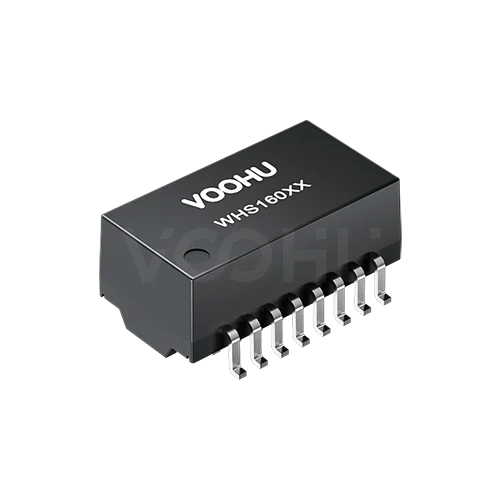
Related product: WHS16037TG, rated −40 to +85 °C for both operation and storage. It handles one 10/100BASE-TX port from 16 SMD leads on a 1.27 mm pitch, measures 12.80 ± 0.50 × 6.90 ± 0.50 mm and stands 5.65 ± 0.50 mm tall, with 350 µH minimum OCL and 1500 VAC isolation for 60 s.
Need a quote, samples or selection support?
Part number WHS16037TG is filled in for you. Add the quantity and lead time and submit. Our FAE team will be glad to confirm the options for your project.
Before you order: samples, MOQ, lead time and import duties in our ordering guide →