Compiled from both manufacturers' published datasheets. Verify with samples and the PCB footprint before production.
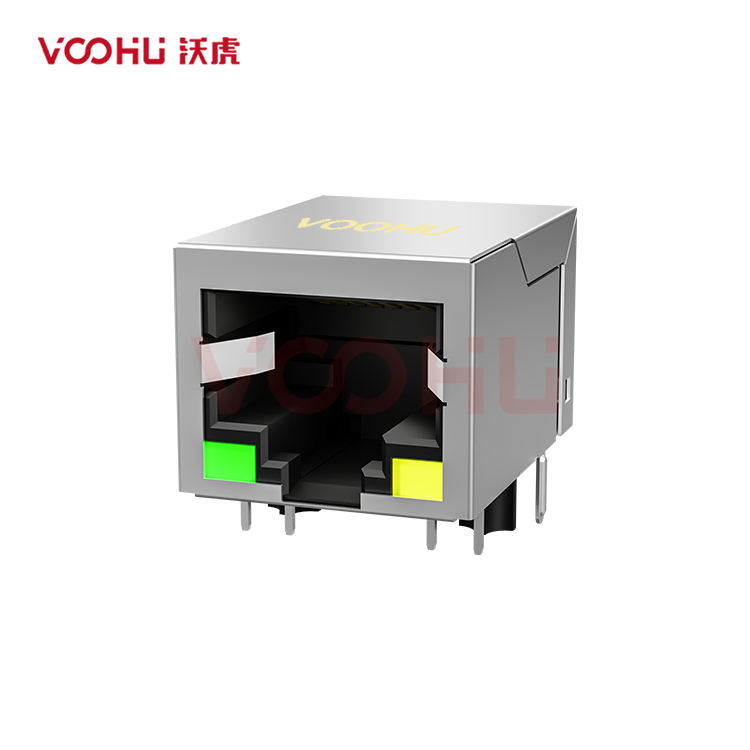
The HanRun HR913129AE is usually on a BOM for one reason: it is the version of HanRun's 1×1 10/100Base-T RJ45 with integrated magnetics that is rated down to −40 °C. The VOOHU SYT111B002BA2A1D is a functional alternative — verify with samples in your design — and its datasheet carries the same −40 to +85 °C operating range. Pin functions, the green-left and yellow-right LEDs and the 350 µH OCL also read the same on both sheets. With temperature off the table, two lines are left to settle before approval, and both live in quality documents rather than in the schematic: the gold thickness on the contact area, and the conditions of the hi-pot test.
#HR913129AE and SYT111B002BA2A1D datasheets, line by line
The HanRun column below is taken from the HR913129AE datasheet, revision 01, a four-page document. The VOOHU column is taken from the SYT111B002BA2A1D datasheet, revision A0, also four pages. Page numbers in brackets point to the sheet a value came from, and "not stated" means that sheet is silent on the item. One more document is worth knowing about if you are searching this part number. HanRun also publishes the HR913550A, and its electrical and material lines read the same as the HR913129AE's; the operating temperature is where they differ, 0 to +85 °C against −40 to +85 °C. If your team has already reviewed the HR913550A, much of that review applies here.
#Why gold-plated connector contacts come up in an RJ45 change: 30 µin vs. 6 µin
Page 4 of the HanRun sheet describes the contact in three parts: phosphor bronze 0.35 mm thick, 30 µin of gold over 50 µin of nickel in the plating area, and 100 µin of tin over 50 µin of nickel in the solder area. The VOOHU sheet uses the same base metal and thickness, phosphor bronze C5210 at 0.35 mm, and gives one plating figure: 6 µin of gold on the contact area. It does not list a nickel underplate or a solder-area finish. Neither sheet says whether its gold figure is a minimum or a nominal value. Both rate the jack for at least 750 mating cycles. That is each supplier's rating for its own part; it is not a comparison of the two platings.
Whether this matters depends on where the gold figure in your documents came from. Open the component specification or AVL entry for the HR913129AE and look for a plating line. If none exists, the qualification simply records the VOOHU values as printed. If one exists and it was copied from the HanRun datasheet, decide with your quality lead whether the line describes a requirement or just the incumbent part, and rewrite it against the approved VOOHU document. If the line traces back to a customer drawing or an end-equipment specification, treat it as a requirement and send it to our FAE team with the sample request, before any qualification lots are ordered. If your incoming inspection measures plating thickness, it should take its acceptance value from whichever document you approve, not from the HanRun sheet by default.
#Hi-pot test time and leakage: 60 s at 0.5 mA, or 6 s at 1 mA?
HanRun rates the HR913129AE isolation at 2250 V DC for 60 s with a 0.5 mA limit, from the UTP side to the chip side. VOOHU rates the SYT111B002BA2A1D at 1500 V AC and 2250 V DC for 6 s with a 1 mA limit, primary to secondary. The DC voltage is the one number the two lines share. Treat each line as the condition under which that supplier rates its own part: a 6 s rating and a 60 s rating are not interchangeable, and neither sheet offers a conversion. For the quality engineer, the practical question is which condition your incoming test and your product's safety file quote. If they quote the HanRun line, ask our FAE team in writing whether the SYT111B002BA2A1D may be tested at 2250 V DC, 0.5 mA, 60 s before a VOOHU lot goes on the tester. If your procedure is written for AC, note that only the VOOHU sheet gives an AC value. The HanRun HR913129AE isolation line is the same as the HR913550A's, so the bench-level steps in our HR913550A comparison apply here unchanged; for why ports fail the test in the first place, see why an Ethernet port fails a hi-pot test.
#HR913129AE operating temperature is matched: what the selection record still needs
For the component engineer, the temperature line can be copied across as it stands: −40 to +85 °C operating and storage on both datasheets, so nothing about the cold-start case changes. The rest of the electrical page matches value for value on OCL, return loss and crosstalk, but three lines are written differently and belong in the record as written. Insertion loss carries the same −1.0 dB limit, specified from 300 kHz on the HanRun sheet and from 1 MHz on the VOOHU sheet; if a design note quotes the loss below 1 MHz, the VOOHU sheet does not state it. The turns ratio is 1CT:1CT on both, and only VOOHU adds a ±2% tolerance. LED forward voltage is a single 1.8–2.8 V window from HanRun and separate green and yellow ranges from VOOHU, so recheck the LED resistor values against the VOOHU figures at your LED drive current. Common-mode rejection is also split into different frequency bands on the two sheets.
#Layout: shield-tab and locating-post holes on an HR913129AE board
Two hole callouts are the ones to check. Both drawings size the shield-tab holes at Ø1.63 mm; the centre distance between them is 15.49 mm for HanRun against 15.75 mm for VOOHU, which by subtraction is 0.26 mm. The locating-post holes keep their 11.43 mm spacing and go from Ø3.25 mm to Ø3.20 mm. On an existing board, test-fit samples in the drilled holes before deciding anything about the artwork. Because the HR913129AE layout page matches the HR913550A's, the full hole and panel review in our HR913550A comparison applies to this part as well.
#Spec lines to rewrite when the HR913129AE gets a second source
Each row is one line in a document your quality or component team owns. The middle columns show what the line says when it is copied from each datasheet; the last column is how to close it.
#Where the SYT111B002BA2A1D fits as an HR913129AE alternative
It fits where the HR913129AE was chosen for its temperature rating: a single 10/100 copper port on a through-hole board, in equipment that has to start and run at −40 °C, such as remote I/O modules, gateways in outdoor cabinets or controllers on unheated sites. Where the component specification has no plating line and the hi-pot procedure can follow the VOOHU datasheet, the change is mostly paperwork plus a sample build. Where either line is fixed by a customer, settle it with our FAE team first.
Industry solutionIndustrialPLC · ServoView solution →#FAQ
Is there a −40 °C RJ45 with magnetics that can replace the HanRun HR913129AE?
The VOOHU SYT111B002BA2A1D is a functional alternative to the HanRun HR913129AE — verify with samples in your design. Both are 1×1 10/100Base-T through-hole RJ45 jacks with integrated magnetics, rated −40 to +85 °C operating, with the same pin functions and green-left, yellow-right LEDs. Check the contact gold thickness and the hi-pot conditions before approval.
What is the difference between the HanRun HR913129AE and HR913550A?
Read side by side, the two HanRun datasheets give the same electrical and material lines. The operating temperature differs: 0 to +85 °C for the HR913550A and −40 to +85 °C for the HR913129AE, with storage at −40 to +85 °C on both. Confirm with HanRun if your approval depends on any other difference.
What hi-pot test time does the HR913129AE datasheet specify?
The HR913129AE datasheet rates isolation at 2250 V DC for 60 s with a 0.5 mA limit, UTP side to chip side. The SYT111B002BA2A1D datasheet rates 1500 V AC and 2250 V DC for 6 s with a 1 mA limit, primary to secondary. Test each part to its own datasheet condition unless the supplier confirms another in writing.
What gold plating is on the HR913129AE contacts?
The HR913129AE datasheet gives 30 µin of gold over 50 µin of nickel in the plating area and 100 µin of tin over 50 µin of nickel in the solder area, on 0.35 mm phosphor bronze. The SYT111B002BA2A1D datasheet gives 6 µin of gold on the contact area, also on 0.35 mm phosphor bronze.
#Send your plating and hi-pot lines with the sample request
When you request SYT111B002BA2A1D samples, attach the pages of your component specification or inspection instruction that mention plating and hi-pot, plus the panel drawing if the front face is tight. The answer can then address the lines you have to sign off, not a general description of the part. Samples are available for evaluation, and selected parts are free of charge. Our FAE team will be glad to confirm the options for your project. Our FAE team can suggest suitable parts and help check the design — here, that means answering whether the contact gold figure is a minimum or a nominal value, whether the jack may be hi-pot tested to your existing condition, and how the shield-tab and post holes on your board compare with the VOOHU drawing.
VOOHU supplies RJ45 and SFP connectors, LAN and PoE transformers and common mode chokes from Suzhou, China, to more than 1,500 customers.
Comparing other single-port jacks with built-in magnetics? The RJ45 connector selector is set to integrated magnetics and tab down, so the list starts from parts in this family.
Related product: SYT111B002BA2A1D — 1×1 through-hole RJ45 with integrated magnetics for 10/100BASE, green and yellow LEDs, −40 to +85 °C operating, isolation rated 1500 V AC and 2250 V DC.
#Sources
- HanRun HR913129AE datasheet, REV 01 (4 pages)
- HanRun HR913550A datasheet, REV 00 (for the HR913550A comparison in Q2)
- VOOHU SYT111B002BA2A1D datasheet, Rev. A0 (4 pages)
Need a quote, samples or selection support?
Part number SYT111B002BA2A1D is filled in for you. Add the quantity and lead time and submit. Our FAE team will be glad to confirm the options for your project.
Before you order: samples, MOQ, lead time and import duties in our ordering guide →