Compiled from both manufacturers' published datasheets. Verify with samples and the PCB footprint before production.
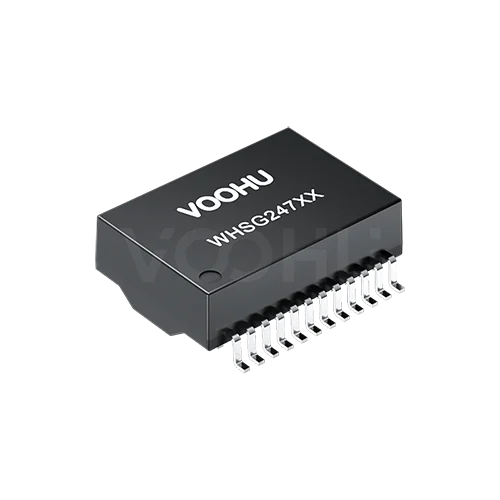
Yes, there is an alternative, with one line on each datasheet worth reading twice. The VOOHU WHSG24706-1PTG is a functional alternative to the Pulse H6062NL — verify with samples in your design. Both are 24-pin, 1.27 mm-pitch SMD single-port gigabit PoE LAN transformers built the same way inside: a three-wire common mode choke on the chip side of each channel, then the transformer, with the line-side center tap brought out as MCT. Pins 1 to 24 carry the same functions one by one, OCL is 350 µH minimum on both, the insertion-loss and return-loss formulas match, and both are tested at 1500 V for 60 s. The line to read twice is PoE current: Pulse prints "350 mA max @ 57 V (continuous)", while item 12 of the VOOHU electrical table gives "802.3at … 720mA Current Capability". The sections below explain why those two figures do not sit on one scale, and what to ask for before either goes into your power budget.
#H6062NL vs. WHSG24706-1PTG: datasheet values side by side
Pulse figures below come from revision D of the H6062NL data sheet, using its notes (sheet 1), schematic and electrical table (sheet 2), and mechanical drawing with suggested land pattern (sheet 3). Pulse dimensions are in inches with millimetres in brackets, under general tolerances of ±0.01 in for two-place and ±0.005 in for three-place figures. Two remarks on sheet 2 matter later in this article: the electrical table is headed "For reference only", and its values are given at +25 °C. VOOHU figures come from revision A0 of the WHSG24706-1PTG datasheet: page 1 for dimensions, pads and schematic, page 2 for the electrical table, which is also stated at 25 °C. Any range or difference worked out from a tolerance is marked calculated.
#H6062NL PoE current rating: what "350 mA max @ 57 V (continuous)" says
Pulse puts its PoE figure in the electrical table as a DC current / voltage rating, and it is worth taking apart before anyone copies it into a design note. It makes three statements. 350 mA is a maximum, a ceiling rather than an operating point. 57 V names the voltage the rating applies at; 57 V is also the upper limit of PSE output voltage in IEEE 802.3 Clause 33, so the figure is set at the top of what a PoE port can present. "Continuous" says the current may flow without a time limit. What the line leaves out matters just as much. It does not say whether 350 mA flows through one MCT pin, one channel or the whole part. It gives no ambient temperature and no allowed temperature rise. And it sits in a table headed "For reference only" with values at +25 °C, on a part rated to operate from 0 to +70 °C.
#Why the H6062NL's 350 mA and the WHSG24706-1PTG's 720 mA are not one scale
The VOOHU line is a different kind of statement. Item 12 of the WHSG24706-1PTG table gives "720mA Current Capability" next to 802.3at, with no voltage, duty or temperature printed beside it, and, like the Pulse line, it does not name a pin, a channel or the whole part. So one figure is a continuous maximum at a stated voltage, and the other is a capability figure whose test conditions are not on the page. Putting 720 next to 350 and reading off a ratio would compare two numbers with different and partly unknown definitions. Work the other way round. Start from the current your own design drives through each center tap at its highest power level and its hottest enclosure ambient, then ask each supplier to confirm its part against that figure under those conditions. For the WHSG24706-1PTG, ask us for the conditions behind 720 mA.
#What to ask both suppliers before PoE current goes into the design file
- 1.Scope. Does the figure apply per MCT pin, per channel, or to all four channels together? A design that powers over two pairs and one that powers over four load the part differently.
- 2.Duty. Continuous, or for a stated time? Pulse says continuous; get the same answer in writing for the VOOHU figure.
- 3.Temperature. The ambient the rating holds at and the winding temperature rise it allows. Both electrical tables are written at 25 °C, and the board inside your enclosure may run hotter than that.
- 4.DC unbalance. How much difference between the two conductors of a pair the rating assumes, and whether that unbalance was present when the OCL figure was measured.
- 5.Winding resistance basis. Pulse lists 0.65 Ω max for half a winding with a ±0.065 Ω unbalance limit; VOOHU lists 1.4 Ω max without naming the section. Ask which terminals each value was measured between before you use either one in a heating estimate.
- 6.Voltage. Whether the VOOHU figure is tied to a port voltage, as the Pulse figure is tied to 57 V.
Most of these answers are not printed on either sheet. Get them in writing and file them with the part approval, so the next person who opens the design note finds the conditions next to the number.
#OCL at 8 mA vs. 14 mA DC bias: setting up incoming inspection
Both sheets set OCL at 350 µH minimum at 100 kHz and 100 mV, but with a different DC current superimposed during the test: 8 mA for the H6062NL, 14 mA for the WHSG24706-1PTG. On the bench that is one setting on the LCR meter's bias source, and it is easy to leave untouched when a second source joins the approved list. An inspection instruction written from the Pulse sheet calls for 8 mA, and a WHSG24706-1PTG measured that way has not been checked at the condition its own datasheet sets. Give each manufacturer part number its own line with its own bias current, keep the readings in separate records, and do not trend new VOOHU readings against an 8 mA history. One more note for the quality file: if the Pulse limits in your current specification were copied from its electrical table, that table is labelled "For reference only", so record which numbers are supplier limits and which came from a reference table.
#Height, land pattern and temperature: the H6062NL figures that move
Height. Pulse draws the H6062NL 0.225 in [5.72 mm] tall with no MAX beside the figure, so 5.72 mm is nominal. Under the drawing's three-place tolerance of ±0.005 in, the tallest part it allows is 0.230 in, about 5.84 mm (calculated). The WHSG24706-1PTG is 6.00 ± 0.50 mm, up to 6.50 mm (calculated). If a shield can, heat spreader or lid rib sits over the magnetics, check that gap against 6.50 mm.
Land pattern. Pad width, 0.76 mm, and the inner edge-to-edge span, 12.70 mm, are the same on both suggested patterns. The outer span is 16.51 mm on the Pulse sheet and 16.60 mm on the VOOHU sheet, so each VOOHU pad ends about 0.045 mm further out (calculated). The foot resting on the pad is 0.045 in [1.14 mm] on the H6062NL and 1.10 ± 0.15 mm on the WHSG24706-1PTG.
Temperature and handling. The H6062NL operates from 0 to +70 °C and the WHSG24706-1PTG from −40 to +85 °C. Storage is −20 to +125 °C on the Pulse sheet and −40 to +85 °C on the VOOHU sheet, so a storage or transport instruction written to the Pulse upper limit should be rewritten to the VOOHU range for this part number. Pulse also gives moisture sensitivity, J-STD-020 Level 1, and a 245 °C reflow maximum; the WHSG24706-1PTG datasheet is silent on both, so if your line set-up needs an MSL entry, request it from us rather than reusing the Pulse value.
#H6062NL to WHSG24706-1PTG: swap checklist
#Where the WHSG24706-1PTG fits
The WHSG24706-1PTG is meant for one gigabit copper port that also carries PoE current through its line-side center taps, on boards that place the magnetics as a discrete SMD part beside a plain RJ45 jack. Its −40 to +85 °C operating range covers equipment specified for that range as well as boards built to the 0 to +70 °C range printed for the H6062NL. We have also compared this VOOHU part with the Bourns PT61020EL and the Bothhand 24HSS1041A-2 HF; both of those place their choke on the line side, which is not the case for the H6062NL.
SolutionPoEData + power on one cableView solution →#FAQ
What is the Pulse H6062NL transformer, and what can replace it?
The H6062NL is a Pulse 24-pin SMD single-port gigabit LAN transformer with a chip-side common mode choke in each channel and a DC current / voltage rating of 350 mA max at 57 V, continuous. The VOOHU WHSG24706-1PTG is a functional alternative — verify with samples in your design. It has the same internal arrangement, the same function on each pin number, 350 µH minimum OCL and 1500 V, 60 s isolation. Check the PoE current conditions, the OCL bias (8 vs. 14 mA), height (5.72 mm nominal vs. 6.00 ± 0.50 mm) and the outer pad span (16.51 vs. 16.60 mm).
PoE current per pair: what do the H6062NL and WHSG24706-1PTG datasheets tell me?
Less than the question needs. Pulse gives 350 mA max at 57 V, continuous; VOOHU gives a 720 mA current capability in its 802.3at line. Neither datasheet says whether its figure is per pair, per center tap or for the whole part, and only Pulse states a duty. Start from your own per-pair current and ask both suppliers for scope, duty and allowed temperature rise.
Ethernet transformer center tap voltage: what does the 57 V on the H6062NL refer to?
It is the voltage at which Pulse states its 350 mA continuous DC current rating through the part. 57 V is also the upper limit of PSE output voltage in IEEE 802.3 Clause 33. Isolation is a separate line on both sheets: 1500 Vrms for 60 s on the H6062NL and 1500 VAC, 1 mA, 60 s on the WHSG24706-1PTG.
Why do the two datasheets measure OCL at different DC bias currents?
Each datasheet sets its own test condition, and neither says why it chose its value: 8 mA for the H6062NL and 14 mA for the WHSG24706-1PTG, both at 100 kHz and 100 mV with a 350 µH minimum. Test each part at its own datasheet condition and keep the records separate.
#Request WHSG24706-1PTG samples with your PoE figures
Three numbers make this evaluation quick: the highest current your port drives through each center tap, the worst-case ambient inside the enclosure, and the gap above the magnetics. Include them when you request WHSG24706-1PTG samples. Samples are available for evaluation, and selected parts are free of charge. Our FAE team will be glad to confirm the options for your project. Our FAE team can suggest suitable parts and help check the design — for this pair, the conditions behind the 720 mA figure for your port, the OCL bias to write into your inspection instruction, and how the leads sit on your existing 16.51 mm pads. VOOHU supplies RJ45 and SFP connectors, LAN and PoE transformers and common mode chokes from Suzhou, China, to more than 1,500 customers.
For other 24-pin gigabit parts, with and without a PoE rating, browse our Ethernet transformers.
Related product: WHSG24706-1PTG, the single-port gigabit PoE LAN transformer compared above: 24 pins on a 1.27 mm pitch, a 12.20 mm wide body standing 6.00 ± 0.50 mm, a chip-side three-wire common mode choke in each channel, 350 µH minimum OCL at 14 mA DC bias, 1500 VAC, 1 mA, 60 s isolation and a −40 to +85 °C operating range.
#Sources
- Pulse H6062NL data sheet, Rev. D, sheets 1–3.
- VOOHU WHSG24706-1PTG datasheet, Rev. A0.
- IEEE 802.3-2022, Clause 33 (Power over Ethernet), PSE output voltage.
Need a quote, samples or selection support?
Part number WHSG24706-1PTG is filled in for you. Add the quantity and lead time and submit. Our FAE team will be glad to confirm the options for your project.
Before you order: samples, MOQ, lead time and import duties in our ordering guide →