
Compiled from both manufacturers' published datasheets. Verify with samples and the PCB footprint before production.
The VOOHU WHS16503G is a functional alternative to the HanRun HY601680 — verify with samples in your design. Both are single-port 10/100 LAN transformers in a 16-pin SMD package on a 1.27 mm pitch, with 1CT:1CT windings, a common mode choke on the line side, 350 µH minimum OCL at 8 mA DC bias, a 1500 V, 60 s isolation test and a 0 to +70 °C operating range, and pin numbers correspond function by function on the two schematics. The catch is the electrical table. HanRun prints most of its return loss, common mode rejection and crosstalk figures as typical values; VOOHU prints every one of them as a minimum. That leaves two lines you can put side by side: insertion loss, and return loss at 80 MHz. On the board, the recommended pads are 0.64 mm wide on the HanRun drawing and 0.76 mm on the VOOHU drawing.
#HY601680 and WHS16503G LAN transformer datasheets, with the limit type on every line
The HanRun column is read from the one-page HY601680 datasheet, REV B/3, which is drawn in inches; the millimetre figures in brackets are converted at 25.4 mm per inch. The VOOHU column comes from the WHS16503G datasheet, revision A0, drawn in millimetres: sheet 1 carries the outline, pad layout and schematic, sheet 2 the electrical table. Each electrical value keeps the word its datasheet prints beside it, Typ, Min or Max, because that word decides whether two cells can be compared. "Not stated" means the datasheet gives no value.
#Typical datasheet values against minimums: which HY601680 lines can you compare?
A minimum or maximum is a limit. The maker commits every part it ships to that number. A typical value describes what a representative part does and promises nothing about the one on your reel. Both datasheets in this comparison print losses as negative decibels, so the usual reading is that −18 dB Min means at least 18 dB of return loss, and −1.1 dB Max means no more than 1.1 dB of insertion loss.
Run the table through that filter and two lines come out as like for like. Insertion loss is −1.1 dB maximum on both sheets; HanRun specifies it from 300 kHz, VOOHU from 1 MHz. Return loss at 80 MHz is the only return loss figure HanRun prints as a minimum, −11.5 dB, and VOOHU's minimum for 60 to 80 MHz is −12 dB. Every other HanRun figure in the return loss, common mode rejection and crosstalk rows is typical: −20 dB at 30 MHz, −14 dB at 60 MHz, −37 and −30 dB of common mode rejection, −45 and −35 dB of crosstalk. The VOOHU cells beside them are minimums. A row that reads −20 dB typical next to −18 dB minimum cannot be subtracted into a margin in either direction, because the two cells are different kinds of number, and the difference says nothing about how parts from either reel will measure.
For the engineer filling in an approved-alternates form, this changes what the baseline is. Add a column for the limit type and fill it from the two datasheets, not from the distributor listing. For common mode rejection and crosstalk the HY601680 sheet gives no guaranteed figure at all, so the HanRun column cannot serve as the pass line. The useful comparison is against what your own design asks for: the PHY maker's reference design, the EMC margin your product already has, or a customer specification. Check each VOOHU minimum against that requirement, and note any line your form covers that the VOOHU sheet does not, such as insertion loss between 300 kHz and 1 MHz. For those lines, ask for data instead of assuming an answer either way.
#What to ask each supplier for before the comparison is closed
- From HanRun or your distributor: guaranteed limits, if any exist, for return loss at 30 and 60 MHz, for common mode rejection and for crosstalk; and the test frequency and voltage behind the 350 µH OCL figure, which the HY601680 sheet does not print.
- From VOOHU: typical or measured values behind any minimum you want to set beside a HanRun typical; data at a 0.5 mA hipot criterion if your inspection uses that limit; and values below 1 MHz if your evaluation covers that band.
- From both: the test conditions behind each electrical line, so that a measurement you make later is compared with the right figure.
#Measuring both parts when a line is still open
When paper cannot settle a line, a bench sweep can. Fit HY601680 and WHS16503G samples on one evaluation fixture, or on two boards from a single PCB lot, and sweep return loss, common mode rejection and crosstalk from 1 to 100 MHz with a network analyzer. Measure several parts of each rather than one, so you see the spread and not a single reading. The result describes your fixture as much as the parts, so judge it against your design requirement, not against either datasheet's typical column. Write incoming inspection against the datasheet minimums, since those are the figures the supplier stands behind.
#HY601680 recommended pads in millimetres, beside the WHS16503G pattern
HanRun dimensions its land pattern in inches: 0.025 in wide pads (0.64 mm), 0.270 in between the inner edges of the two rows (6.86 mm) and 0.420 in across the outer edges (10.67 mm), all converted at 25.4 mm per inch. The VOOHU drawing gives 0.76 mm wide pads, 7.10 mm between the inner edges and 10.60 mm across the outer edges, all typical. Centred on each other, the VOOHU pads are 0.06 mm wider on each side, begin 0.12 mm further from the body centreline at the inner edge, and end about 0.035 mm short of the HanRun outer edge (all calculated). Width and the inner edge are where the two patterns part most.
For a Layout engineer with an HY601680 board already built, the width line matters most for the stencil and the side fillets. The WHS16503G lead is 0.46 ± 0.10 mm wide, so 0.36 to 0.56 mm across its tolerance; the HY601680 lead is 0.020 ± 0.005 in, or 0.51 ± 0.13 mm, which puts its upper limit at the 0.64 mm pad width (converted and calculated). Neither datasheet says how the WHS16503G sits on HanRun-sized pads, and we have no written FAE confirmation for it, so treat the existing board as a first-article trial. Place a few parts, inspect heel and side fillets on pins 1, 8, 9 and 16, and keep the HanRun stencil apertures only if those joints pass your workmanship standard. Check that the AOI library takes the new lead width. For a new layout, draw the land pattern from the VOOHU drawing. Height needs only a library edit: 4.95 ± 0.50 mm, at most 5.45 mm (calculated), against 0.225 in (5.72 mm) maximum for the HY601680, so the clearance you kept above the HanRun part still covers it; update the 3D model and the height field.
#Incoming inspection lines to rewrite for the WHS16503G
Quality teams can keep the hipot voltage and time: 1500 V for 60 s on both sheets. The pass criterion moves. HanRun states the test at 0.5 mA, primary to secondary (1500 Vrms, 60 s), and VOOHU states it at 1 mA, so write the WHS16503G line as 1500 VAC, 1 mA, 60 s. If a customer file or safety report fixes you at 0.5 mA, ask us for data at that criterion before you change the tester; our article on why an Ethernet port fails a hipot test covers the isolation path itself. For OCL, set the meter to VOOHU's printed conditions, 100 kHz, 0.1 V and 8 mA DC, since the HanRun sheet names only the bias current. Three lines can be added that the HY601680 sheet does not carry: 0.5 µH maximum leakage inductance, 1400 mΩ maximum DCR and the ± 5% turns-ratio tolerance. Electrical acceptance belongs on the minimum and maximum columns, never on a typical.
#HY601680 to WHS16503G: verification checklist
#Which 10/100 designs suit the WHS16503G
The WHS16503G is a 10/100 LAN transformer for one copper port, placed between the PHY and a separate RJ45 jack, in equipment that stays inside 0 to +70 °C, the operating range on both datasheets. It is easiest to qualify where the design already has a written requirement for return loss, common mode rejection and crosstalk, because the VOOHU minimums can then be checked against it line by line. If your HanRun BOM carries other magnetics or jacks, our HanRun cross reference lists the VOOHU parts compared so far; if this board started life on a Mentech H1601CG, our H1601CG comparison covers that footprint.
SolutionEthernetInterface + magneticsView solution →#FAQ
What is an equivalent for the HanRun HY601680 10/100 LAN transformer?
The VOOHU WHS16503G is a functional alternative to the HanRun HY601680 — verify with samples in your design. Both are 16-pin SMD single-port 10/100 transformers on a 1.27 mm pitch with 1CT:1CT windings, a line-side common mode choke, 350 µH minimum OCL at 8 mA DC, a 1500 V, 60 s isolation test and a 0 to +70 °C rating. Before approving it, note which electrical lines are typical on the HanRun sheet and compare the recommended pad widths, 0.64 mm and 0.76 mm.
Return loss vs. insertion loss: what is the difference on a LAN transformer datasheet?
Insertion loss is the signal lost passing through the transformer; return loss describes how much is reflected back toward the source at impedance discontinuities, so a larger return loss in dB (a more negative figure as these two datasheets print it) means less reflection. For this pair, insertion loss is −1.1 dB maximum on both sheets. Return loss is where the limit types differ: HanRun gives typical values at 30 and 60 MHz and a minimum of −11.5 dB at 80 MHz, while VOOHU gives minimums across 1 to 80 MHz, −12 dB at 60 to 80 MHz.
Is a typical value on a datasheet guaranteed?
No. A typical value describes a representative part; only a minimum or maximum commits the supplier for every part. On the HY601680 sheet, the 30 and 60 MHz return loss figures, common mode rejection and crosstalk are typical. On the WHS16503G sheet the corresponding lines are minimums. Base acceptance on the guaranteed columns, and ask the supplier for limits where only a typical is printed.
What inductance do the HY601680 and WHS16503G specify?
Both datasheets give 350 µH minimum open-circuit inductance with 8 mA of DC bias. The WHS16503G sheet adds the test signal, 100 kHz at 0.1 V. The HY601680 sheet does not print a test frequency or voltage, so if your inspection compares readings across the two parts, run both at one set of conditions.
HY601680 datasheet pinout: which pins carry the transmit and receive pairs?
On the chip side, pins 1 and 3 are the transmit pair with its center tap on pin 2, and pins 6 and 8 are the receive pair with its center tap on pin 7. On the cable side, pins 16 and 14 carry the transmit pair with a center tap on pin 15, and pins 11 and 9 the receive pair with a center tap on pin 10. The WHS16503G schematic assigns its TD, RD, TX and RX pins to those pin numbers; confirm against both drawings when you update the symbol.
#Getting WHS16503G samples for your comparison
The quickest route to a decision is a request that shows us your form. When you request WHS16503G samples, attach the alternates sheet with its limit-type column, the return loss, common mode and crosstalk figures your design has to meet, and the pad dimensions on your current HY601680 board. Samples are available for evaluation, and selected parts are free of charge. Our FAE team will be glad to confirm the options for your project. Our FAE team can suggest suitable parts and help check the design — for this pair, which WHS16503G lines answer each row of your form, what data sit behind the printed minimums, and how the leads land on HanRun-sized pads. VOOHU supplies RJ45 and SFP connectors, LAN and PoE transformers and common mode chokes from Suzhou, China, to more than 1,500 customers.
To look at other single-port 16-pin options, browse our Ethernet transformers and filter by speed, pin count and pitch.
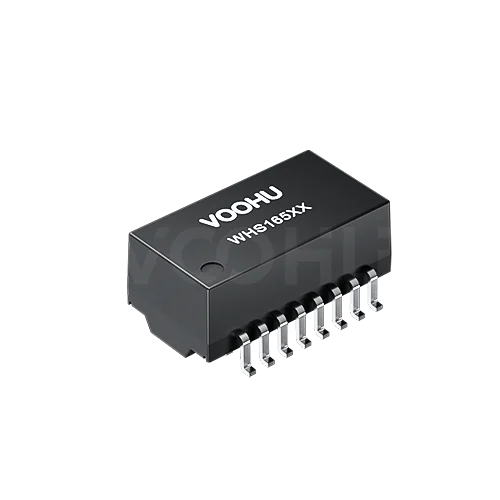
Related product: WHS16503G. One 10/100BASE-TX port in a 16-lead SMD package on a 1.27 mm pitch, 12.70 × 6.85 mm and 4.95 ± 0.50 mm tall, with 1CT:1CT windings and a line-side common mode choke. The datasheet gives 350 µH minimum OCL at 100 kHz, 0.1 V and 8 mA DC, return loss as minimums from 1 to 80 MHz, common mode rejection and crosstalk as minimums from 1 to 100 MHz, a 1500 VAC, 1 mA, 60 s hipot and 0 to +70 °C operation.
#Sources
- HanRun HY601680 10/100BASE-T Single Port Transformers Module datasheet, REV B/3 (one page, distributor-hosted copy).
- VOOHU WHS16503G datasheet, Rev. A0.
Need a quote, samples or selection support?
Part number WHS16503G is filled in for you. Add the quantity and lead time and submit. Our FAE team will be glad to confirm the options for your project.
Before you order: samples, MOQ, lead time and import duties in our ordering guide →